
With approximately 76 million babies born between 1946 and 1964, in the mid-1960s almost four out of ten Americans were baby boomers. Yet, by July 1964 the Census Bureau estimated that there were only 72.5 million baby boomers in the United States since some had already died.

They were replenished by immigrants. In fact, due to immigration, the peak year for baby boomers was 1999 when there were 79 million living in the United States. Since the U.S. population also kept growing, they then constituted about 28% of all residents, still a huge cohort but not quite as overwhelming as when they were young. As recently as 2012, there were 76 million baby boomers. According to the Population Reference Bureau, although 11 million baby boomers had died by then, they had been replaced by an equivalent number of immigrants.
The Pew Research Center estimates that there are 65 million baby boomers alive today. This chart shows how their numbers are expected to decline precipitously over the next 30 years, dropping to just a million by 2062.
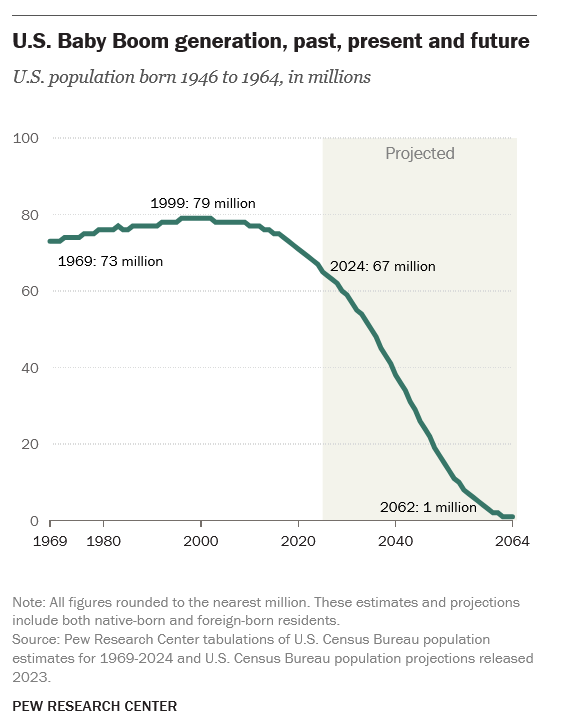
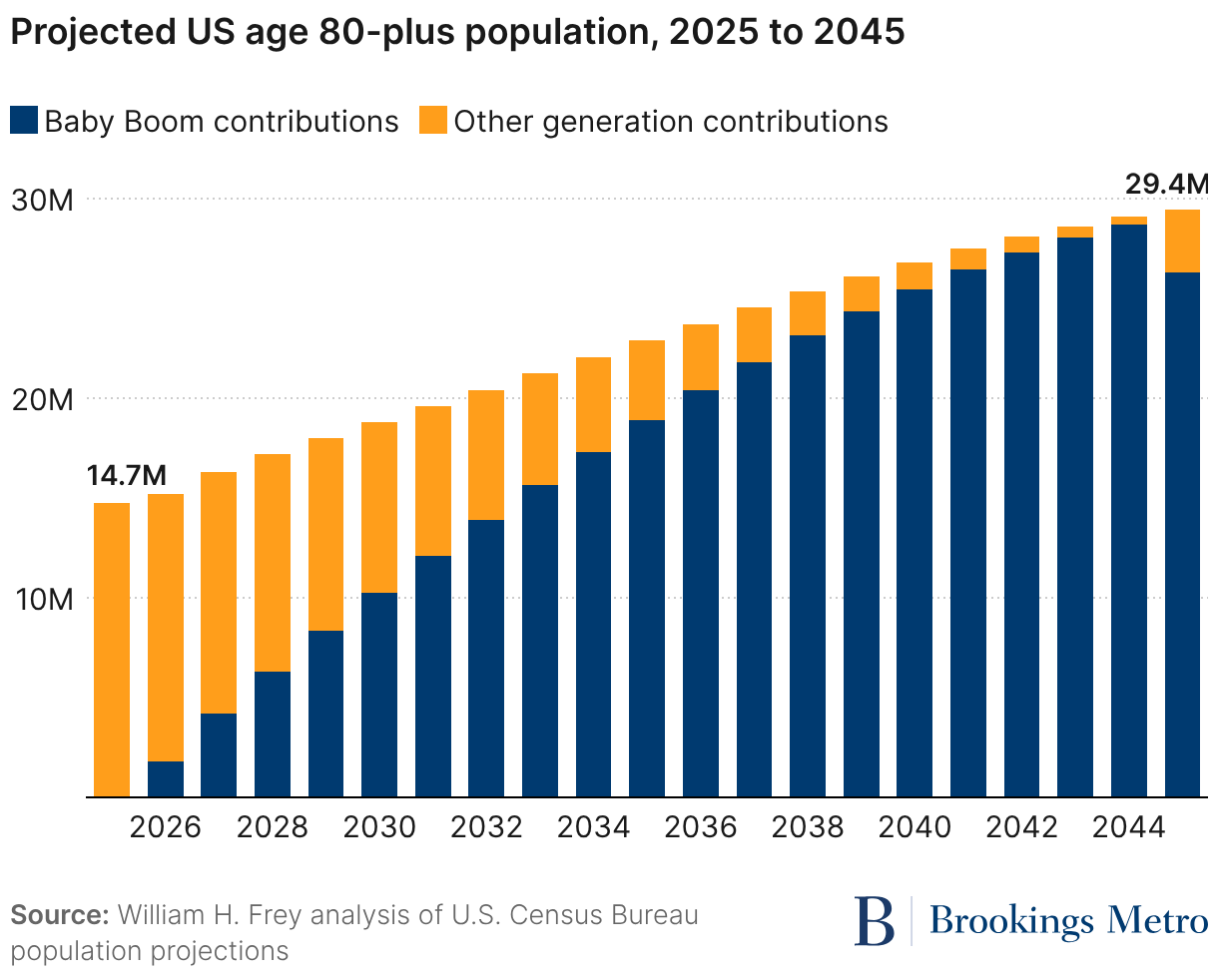
In 2049, when all baby boomers will be 85 or older, Pew projects that there will still be 17 million living. The Brookings Institution projects that the 80-and-over population will double from 14.7 million in 2025 to 29.4 million in 2045.
Interestingly, 2045 will mark the beginning of a changeover in the 80-plus population with generation X moving into their later years. The chart below portrays the baby boomer portion of the 80-and-over population in blue and shows a huge change between 2044 and 2045 when the number of baby boomers will begin declining rapidly due to deaths at the same time that the oldest members of generation X will be having their 80th birthday parties.
Going back to the 85-and-over population, the Brookings Institution projects that between 2025 and 2045 it will grow from 8.3% to 15.9% of the 60-plus population in the United States. Americans 70 and over will grow from 12.9% to 17.2% of the entire U.S. population over the same two decades, a slower growth rate than the 95-plus cohort as the senior population skews older.